Commercial · Linwood
Panic & Exit Hardware in Linwood
The daycare wants the yard gate and the classroom door alarmed so a staff member hears the moment it opens, without turning either into something a child could be shut behind.
Panic & Exit Hardware
In plain words
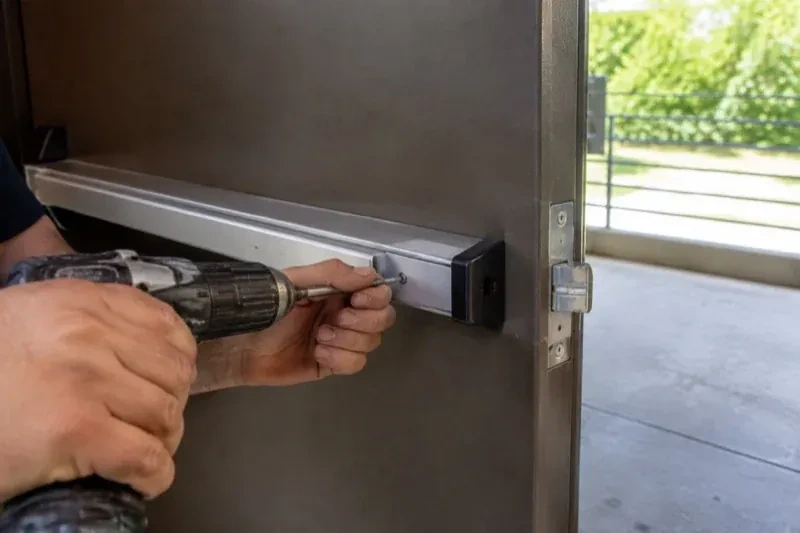
A code trigger usually starts the conversation: an occupant load over a threshold, a fire inspector's note, or a new use for a room that used to hold far fewer people. From there the visit works out which openings are affected, what device and trim suit each one, and whether a pair of doors needs a coordinator or a mullion removed. The installation follows a template, and every device is tested for release force and full latch engagement before the visit ends, with a written record of what went on the door for anyone reviewing the space afterward.
How the visit goesThe new access-control reader at the staff entrance works fine going in, but nobody has sorted out the door's exit side, and right now a card reader and a pushbar exist as two separate ideas.
Linwood
How the visit goes
Confirming why the door needs this hardware
The visit starts with the reason exit hardware is being discussed at all: an occupant load that has crossed a threshold, a fire inspector's note, a new use for the room, or an existing device that has stopped working the way it should. Confirming this first decides everything downstream, because a door required to have a releasing device is treated differently from one where an owner simply wants easier egress. Whoever is responsible for the building is asked directly what triggered the visit, and the answer is recorded alongside the door it concerns before any hardware is chosen.
Fitting outside trim that still controls entry
The inside of the door stays simple: push to leave, every time. The outside gets whatever lets the right people in, a plain pull for a door nobody needs to unlock from outside, a lever with a key cylinder for staff entry, or a keyed cylinder alone where entry is occasional. Whichever trim is chosen, it operates entirely independently of the inside crossbar, so locking the outside never has any effect on a person's ability to leave from within.
A door that opens under one motion, every time
What the space has afterward is straightforward: anyone inside can leave through that door with a single push on the crossbar or touchpad, no key, no second step, no need to remember which way a lock turns. Staff can be shown the motion once and it stays intuitive, because that is exactly what the hardware is built to do. Outside, entry still works the way it was set up to, through the trim chosen for that door, entirely separate from the exit function inside.
Panic & Exit Hardware
In the van
- Door closer
- Request-to-exit switch
- Coordinator for door pairs
- Signage and labels
- Strike and reinforcement
What affects the quote
Same fees day, night or weekend
1Door and frame condition
A door that has sagged, a frame that has shifted, or a strike pocket that no longer lines up needs correcting before hardware is fitted, which adds its own line to the quote.
2Access-control integration
Where the door ties into an existing access-control panel, coordinating the exit hardware's signals with that system takes planning with whoever maintains it, which the quote accounts for separately from the device itself.
3Access to the opening
A ground-floor commercial door is straightforward to reach. An opening behind scaffolding, up a stairwell with no elevator, or in a space still under active construction takes longer to work at.
Panic & Exit Hardware: questions
Can a padlock or extra deadbolt stay on a door that has this hardware?
No additional fastening should stay on an exit door that does not release the same way the primary device does. A hasp, padlock or separate deadbolt added at some point for extra security is a common finding on an older door, and removing or replacing it with something that releases under the same push is part of bringing that opening back to a single, reliable exit.
What does the finished installation actually prove to an inspector?
It proves that a specific device, rated for the opening it sits on, releases under an appropriate force, latches fully, and has been tested and recorded on a given date. The record travels with the building, so a fire inspector reviewing the space later is looking at a documented history of that exit rather than testing hardware with no known installation date or specification.
What counts as panic hardware?
Panic hardware is a door-latching device, usually a crossbar or touchpad running most of the door's width, that releases the latch the moment someone pushes on it from the inside. It is built and tested so a light, even push anywhere along the bar opens the door, which is why it is chosen for doors serving rooms with enough people that fumbling for a key during an exit is not acceptable.
Commercial Locks
- Master Key System DesignA property manager taking over a small commercial building inherits a shoebox of keys with no…
- Access Control InstallationYou just leased the empty unit next door and want the new tenant to open their own suite without a…
- Commercial-Grade Lock ReplacementAn inspection report flagged the rear exit as needing hardware that opens with one motion and no…
Panic & Exit Hardware near you
For a household in Linwood the common requests are a rekey after moving in, a lockout, a deadbolt that grinds, and a lock that finally needs replacing. For a business they are storefront hardware, staff key control and exit devices. Both lists, and a few less common jobs, are laid out here.