Commercial · Bamberg
Access Control Installation in Bamberg
You just leased the empty unit next door and want the new tenant to open their own suite without a key to yours, to the loading dock, or to the electrical room down the hall.
Access Control Installation
In plain words
An exit door does not stop being an exit once it is wired into an access control system. A magnetic lock on that route is paired with a request-to-exit device so anyone leaving is never held up looking for a code, and it is tied into the fire alarm so an alarm signal releases the door on its own. The installation is planned around the building's exits from the start rather than added around them afterward, so the system controls who comes in without complicating how people get out.
How the visit goesThe keypad on the side door has started sticking on cold mornings, codes get shared instead of reset, and half the staff still remember a code you meant to retire two hires ago.
Bamberg
How the visit goes
Sorting out a shared entrance
In a multi-tenant building, the survey has to account for doors that are not fully any one tenant's to control: a shared lobby, a parking garage entrance, a rooftop or mechanical room a landlord manages separately. The locksmith works out with the property manager and each tenant which credentials belong on which controller, so a tenant's staff can reach their own suite without gaining access to another business's space or to areas the landlord keeps under its own control, and so a departing tenant's credentials can be removed without touching anyone else's.
Fitting a magnetic lock with its release device
A magnetic lock is mounted to the head of the frame with a matching armature plate on the door, and it is never installed alone: a request-to-exit device, usually a motion sensor or a mechanical push bar, is wired in to drop power to the magnet the moment someone inside moves to leave, and a connection to the fire alarm panel does the same the instant an alarm activates. The lock is aligned so the plate meets the magnet squarely across the full swing of the door, since even a small gap lets a determined push defeat the hold.
Keeping the battery backup and hardware ready
A controlled door depends on power reaching the controller, the lock, and the reader, so battery backup is worth specifying and sizing for that opening rather than assumed to come standard, so a short outage does not leave anyone locked out or, on a fire-alarm-tied opening, locked in. That backup, where fitted, is worth checking periodically, along with the request-to-exit device on any magnetic lock, since both need attention between visits; a fail-secure lock can stay locked from the secure side once power is gone even where people can still leave freely. A short test, a few times a year, catches a fading battery early.
Access Control Installation
In the van
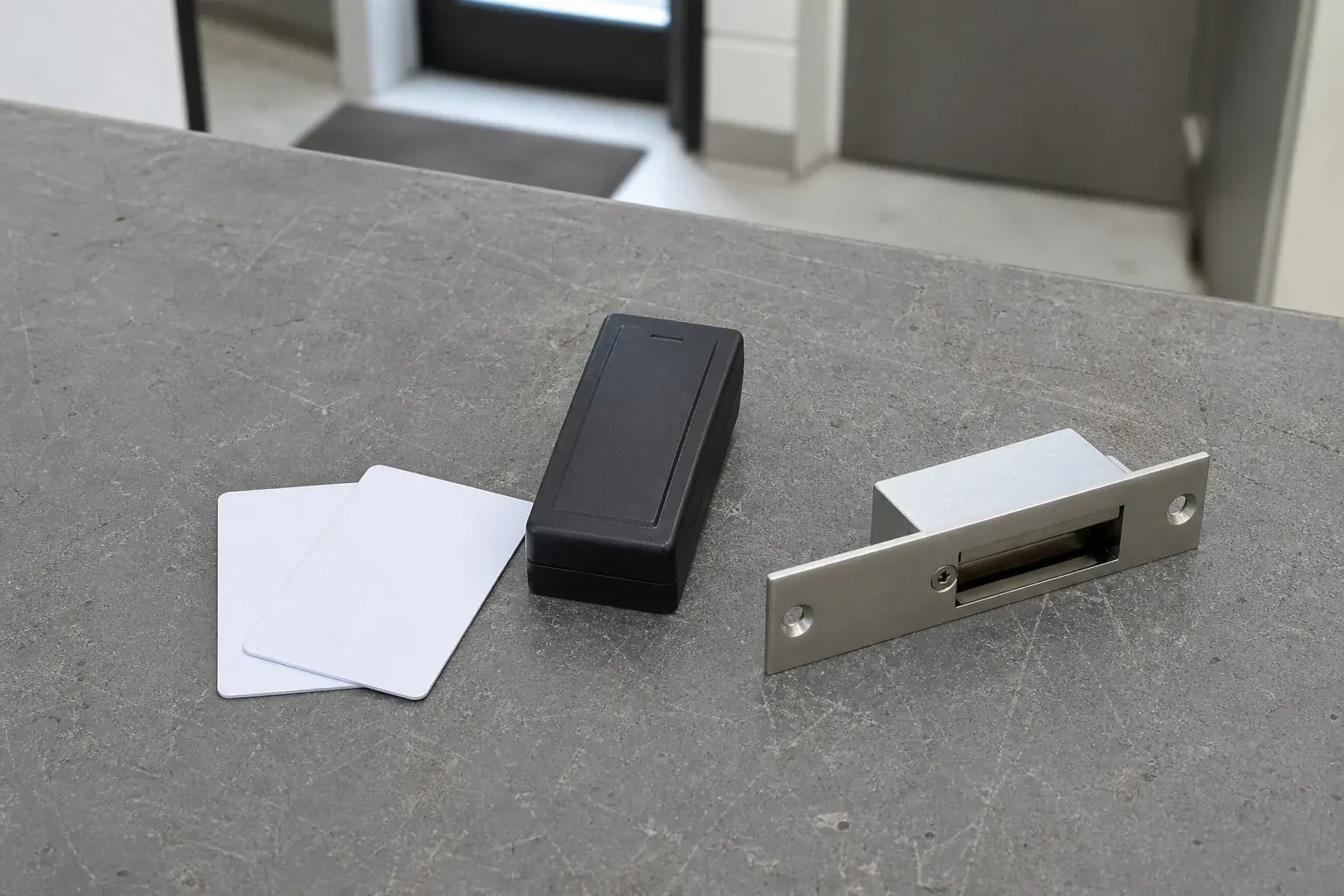
- Request-to-exit devices
- Mechanical override cylinders
- Low-voltage cable
- Electric strikes
- Keypad readers
What affects the quote
Same fees day, night or weekend
1Power supply and backup sizing
A power supply and battery backup have to be sized to the number of doors and locks they support, and a building with several openings on one controller needs a larger supply than a single standalone unit.
2Room left for future doors
Sizing the controller and power supply with some spare capacity for a door or two added later costs a little more at installation but avoids a second controller purchase when the building later adds an opening.
3How many credentials and what type
Cards, fobs, keypad codes and mobile credentials each involve different issuing steps, and a system enrolling a handful of managers is a shorter task than one enrolling an entire staff across several shifts.
Access Control Installation: questions
What maintenance does the system need going forward?
Ongoing maintenance is light: checking the battery backup and the request-to-exit device periodically, keeping reader surfaces reasonably clean, and revoking credentials promptly once someone leaves. Door and frame alignment is worth a look at each change of season, since a shifted door can affect how cleanly an electric strike or a magnetic lock releases.
What credential types are available: cards, codes, fobs, phones?
A proximity card or fob held near a reader, a code typed on a keypad, or a mobile credential read from a phone are all in common use, and a single building can mix them by door or by person. Cards and fobs are simple to issue and switch off individually; a keypad needs no card to lose but a shared code eventually gets passed around; a mobile credential ties entry to a device the person already carries.
How do you decide where the readers and door hardware physically go?
A short walk-through maps which doors get used most, where wiring can run cleanly, and where a reader sits at a comfortable reach for everyone, including anyone using a wheelchair or a cart. Door swing and nearby glass affect where a strike or a magnetic lock sits, and mounting height gets checked against the existing door hardware so nothing interferes with the handle or closer. That walk-through happens before ordering hardware so the layout matches the building rather than the other way around.
Commercial Locks

- Master Key System DesignA property manager taking over a small commercial building inherits a shoebox of keys with no…
- Panic & Exit HardwareThe daycare wants the yard gate and the classroom door alarmed so a staff member hears the moment…
- Commercial-Grade Lock ReplacementAn inspection report flagged the rear exit as needing hardware that opens with one motion and no…
Access Control Installation near you
For a household in Bamberg the common requests are a rekey after moving in, a lockout, a deadbolt that grinds, and a lock that finally needs replacing. For a business they are storefront hardware, staff key control and exit devices. Both lists, and a few less common jobs, are laid out here.